Chapter 4 of 5
Inside the Museum
A rent office that moved, a firehouse built for one truck and an apartment restored down to the icebox.
The Badin Historic Museum began with a fire engine nobody wanted to see sold and a little building that had to get off company land. A quarter century later it fills three buildings and part of a town green, and it is still run entirely by volunteers.
One small building, five lives
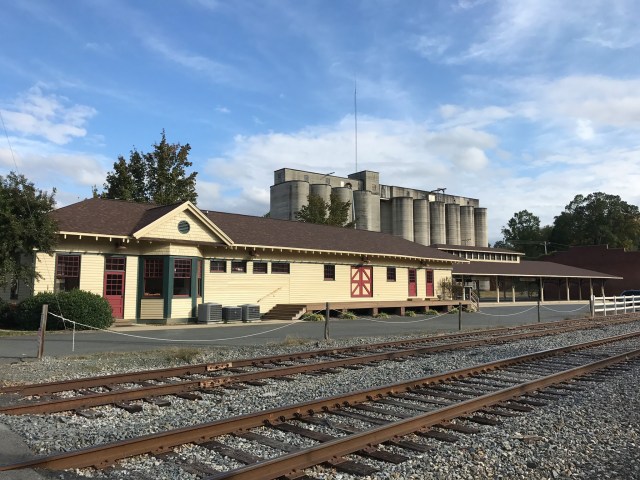
The white frame building at the corner of Falls Road and Pine Street has been in Badin as long as Alcoa has. It has just not always been in the same place, or doing the same job.

The building today, in black and white. Courtesy Badin Historic Museum. Rent office
Alcoa builds a small office at Falls Road and Maple Street for its property and rental business. In a company town, this is where tenants deal with their landlord.

A Badin street in the 1920s. Courtesy Badin Historic Museum. Kindergarten
The rental office moves into the new Commercial Block, the museum says, and the little building becomes the town kindergarten. A Stanly News & Press history column dates the kindergarten years from about 1917 to 1935.

A Badin band, from the museum’s collection. Courtesy Badin Historic Museum. Community building
When kindergarten enrollment drops, the building becomes a popular meeting place: the Red Cross, the Home Demonstration Club, school events and private parties.

The building rides a truck to its new corner. Courtesy Badin Historic Museum. The move
Alcoa gives the building to the town on the condition that it leave company property. Better Badin, Friends of Badin and other volunteers raise the money, and a truck hauls it one block to Falls Road and Pine Street. The Stanly News & Press dates the move to May 12, 1999.

The main museum at 60 Falls Road. Courtesy Badin Historic Museum. The main museum
The Town of Badin still maintains the property. The exhibits inside belong to the museum: the Hardaway Site, a picture history of early town life and memorabilia from the Badin Theater.
From the museum’s archive: The Museum’s First Building
Old 37, and the firehouse built around it
Badin’s fire department dates to 1916, when the Tallassee Power Company and the men of the town formed a volunteer company. Its first equipment was two hand-pulled hose carts made in 1909, a small chemical cart and a hook-and-ladder rig, kept in a stable the French had built north of Walnut. In 1937, Carolina Aluminum bought the department a real engine: a Ford American LaFrance.


By the 1990s the engine had been retired to ceremonial duty, and the department needed the room for modern trucks. Summerlin kept it from being sold. A museum brochure posted by Stanly County says the museum bought a small lot beside the quadruplex in 2003. In 2004, volunteers and friends put up a frame firehouse with a garage door wide enough to back the engine in.

| Make | Ford chassis with American LaFrance fire apparatus |
|---|---|
| Year | 1937 |
| Bought by | Carolina Aluminum, for the Badin fire department |
| Replaced | Hand-pulled hose carts and neighborhood hose houses |
| Paint | Silver |
| Status | On permanent loan from the Badin Volunteer Fire Department |
| Still runs? | The museum says it turns out once a year for the Palestine Christmas Parade |
The firehouse holds more than a truck: hose reel carts, a fire whistle, a telephone switchboard, Badin High School basketball and cheerleading uniforms, and a long photo history of the Narrows Dam going up and of the work at Alcoa. The brochure counts 250 photographs from Alcoa’s files. A hose house, one of the small sheds that once stood around town with hose at the ready, sits in the yard. A glass-paneled door lets you see the engine even when the museum is closed.
From Nov. 20 through Dec. 22, 2026, the firehouse is also a bakery counter: the museum’s Mrs. Pumpkin’s and Dewey’s Holiday Store sets up inside.
From the museum’s archive: Firehouse Museum VFD Hose Cart
The apartment that came back
In 2004, while the firehouse was still being planned, the quadruplex next door came on the market. The museum bought it and set out to return an apartment to its original state. That took fundraising and, in the museum’s words, two years of mostly sweat labor.


Word went out that the museum was looking for furnishings, and the town answered. The original floors were refinished to a high gloss. The downstairs bathroom was restored. The kitchen got an icebox and a wood-burning cookstove, the original china hutch was repaired, and a parlor stove went into the front room. Some of the furniture came from the estate of Alva Hawkins, a longtime resident. Visitors often say it reminds them of a grandmother’s house.
From the museum’s archive: French Quadruplex
Out on the green


- The water wheel. A 28,400-pound stainless-steel turbine runner that worked in the Narrows powerhouse from 1988 to 2009. It stands at Falls Road and Boyden Street, where the walking tour begins.
- The gazebo. Built in 1997, two years before the museum opened.
- The Spark Plug. The body of an Edwards rail car, on its own length of track. Chapter 5 tells its story.
- The empty lot. The museum owns the old Commercial Block site at Yadkin Court and Pine Street, and hopes to put a Hardaway museum there.
The Hardaway connection
The main museum’s best-known exhibit covers a place most visitors have never heard of. The Hardaway Site, on a ridge above the Narrows, was used by people for thousands of years, and its layers of stone tools helped archaeologists work out the order of early cultures across the eastern United States. It was named a National Historic Landmark in 1990.


The museum displays points, grinding stones and the story of the dig. Its partner, the Hardaway American Indian Museum Foundation, shares its hope of a dedicated Hardaway museum in Badin. The Guide tells the site’s story in The Hardaway Site: Twelve Thousand Years on a Ridge Above Badin Lake.
From the museum’s archive: The Hardaway Site Commercial Block Demolished
How a volunteer museum works
The museum’s mission has three parts: to record and maintain the history of the 1913 town of Badin; to preserve and protect its artifacts, photographs and documents; and to display that inheritance respectfully for others to experience.
All of it is done by volunteers. The museum is a 501(c)(3) nonprofit that runs on donations from visitors, the community and corporate supporters. It needs guides for Sunday afternoons and people who are good with computers, because a museum is mostly record keeping. If you have a piece of Badin history to give, the museum asks you to set up a time to bring it in. Tuesdays are preferred.
History courtesy of the Badin Historic Museum. This page retells research and photographs the museum publishes at badin-museum.org, in the Guide’s own words, with links back to the original articles. Go see the real thing: admission is free.
See it in person
The Badin Historic Museum is at 60 Falls Road in downtown Badin. It is open Tuesdays from 9 a.m. to noon and 1 to 3 p.m., and Sundays from 2 to 5 p.m. Admission is free.
Open Tuesdays and Sundays
Sources for this chapter
- Badin Historic Museum: The Museum’s First Building
- Badin Historic Museum: Firehouse Museum
- Badin Historic Museum: French Quadruplex
- Badin Historic Museum: VFD Hose Cart
- Badin Historic Museum: Visit
- Badin Historic Museum: Support and mission statement
- Stanly News & Press: Badin honors town’s museum founder at open house (June 1, 2021)
- Stanly News & Press: Peeking into the past, Badin Museum (April 1, 2025)
- Stanly County: Badin Museums brochure
- National Historic Landmark: Hardaway Site
Photographs are from the Badin Historic Museum’s website and collection, used with credit to the museum. The Stanly County Guide is independent and is not operated by the museum. Spot an error? Tell us. Updated November 14, 2026.