Chapter 5 of 5
The Spark Plug
A gasoline “doodlebug” built in Sanford once carried Badin to its trains. The museum is bringing it back.
In the 1920s you did not need a locomotive to leave Badin. You needed the Spark Plug: a single gasoline rail car, half bus and half train, that shuttled between the depot and the main line. Most cars like it were scrapped generations ago. One is sitting on a short length of track beside the Badin Historic Museum, wearing a fresh coat of red paint.
The car that met the trains
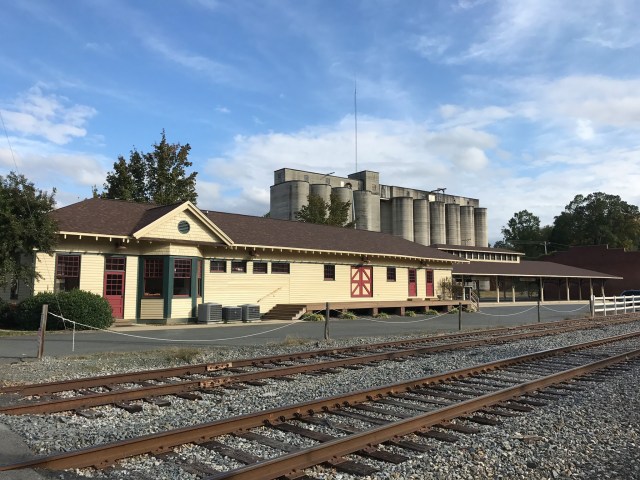
The Badin depot opened in 1916. Within a few years buses, trucks and automobiles were pulling riders away from branch lines everywhere, and a steam train with a crew of five was an expensive way to carry a handful of passengers. The answer, in Badin as in hundreds of American towns, was a motor car on rails.
The museum’s history of the depot says a single gasoline-powered car, known as the Spark Plug or the Skeeter, took over the public run in 1920. It carried up to thirty passengers and made two round trips a day to Halls Ferry Junction, where riders changed for the main line. From there the Yadkin Railroad ran north to Salisbury and south to Albemarle and Norwood.


From the museum’s archive: Badin Train Depot The Spark Plug Project
Ride the timetable
A Yadkin Railroad timetable in the museum’s collection, Table 84, shows how the connection worked. Pick a direction.
| Stop | Time | Miles from Salisbury |
|---|---|---|
| Salisbury | 9:35 a.m. | 0 |
| Granite Quarry | 9:50 | 5.0 |
| Crescent (flag stop) | 9:59 | 8.6 |
| Rockwell | 10:04 | 10.3 |
| Gold Hill | 10:16 | 15.0 |
| Misenheimer Springs | 10:26 | 19.0 |
| Richfield | 10:31 | 21.0 |
| New London | 10:39 | 24.0 |
| Halls Ferry Junction (change to the Badin car) | 10:45 | 25.0 |
| Whitney | 11:05 | 31.2 |
| Badin | 11:20 a.m. | 36.2 |
| Stop | Time | Miles from Salisbury |
|---|---|---|
| Badin | 4:25 p.m. | 36.2 |
| Whitney | 4:39 | 31.2 |
| Halls Ferry Junction (change to the northbound train) | 4:59 | 25.0 |
| New London | 5:16 | 24.0 |
| Richfield | 5:23 | 21.0 |
| Misenheimer Springs | 5:29 | 19.0 |
| Gold Hill | 5:39 | 15.0 |
| Rockwell | 5:51 | 10.3 |
| Crescent (flag stop) | 5:55 | 8.6 |
| Granite Quarry | 6:04 | 5.0 |
| Salisbury | 6:20 p.m. | 0 |
The same table lists a second pair of Badin runs: car No. 102 left Badin at 9:30 a.m. for New London, and No. 103 left New London at 5:20 p.m. and was back in Badin at 5:55. A note adds that the Badin cars would stop on signal at Isenhour.

Built in Sanford
Railroaders had plenty of names for self-propelled coaches: rail buses, motor coaches and, most often, doodlebugs. Badin’s came from Sanford, in the middle of the state.
Harry P. Edwards, general manager of the Atlantic & Western Railway in Sanford, built his first motor car in 1915 because he could not find one a short line could afford. He borrowed from the truck and bus business, organized the Edwards Railway Motor Car Company in 1921 and by 1923 had a standard design, the Model 10. That year the company sold 17 motor cars and five trailers. Customers could order the body longer or shorter to fit their traffic, which the bigger builders did not offer.


The museum notes that a Model 10 sold to Nevada’s Tonopah & Goldfield Railroad in 1926 cost $10,465. By the time Edwards stopped building cars in the early 1940s it had turned out about a hundred, roughly a third of them for Central and South America. Some counts run higher. Badin’s car, the museum says, is a Model 10 built in 1924 for the Carolina & Northwestern Railway.
| Builder | Edwards Railway Motor Car Company, Sanford, N.C. |
|---|---|
| Model | Model 10, the company’s standard design from 1923 |
| Engine | Six-cylinder gasoline, 80 horsepower |
| Seats | 15 to 30, depending on the body ordered |
| Weight | 16,000 to 19,000 pounds |
| Drive | Four-speed transmission, with chains to both axles of the rear truck |
| Bearings | Roller bearings throughout, which kept running costs low |
| Crew | One driver, where a steam train needed five |
From the museum’s archive: The Spark Plug Project The Spark Plug (first article)
The restoration, step by step
The museum has photographed the work as it goes, and posted these pictures in the fall of 2025.

The car body before restoration. Courtesy Badin Historic Museum. What was left
What survived was the steel body: rusted, with its windows long gone.

Loading the car. Courtesy Badin Historic Museum. On the truck
The body was loaded onto a flatbed trailer for the trip to Badin.

The car arrives. Courtesy Badin Historic Museum. On the museum grounds
Set down on the museum grounds, with a sign that reads Badin 100, The Spark Plug, Badin to Hall’s Ferry Junction Shuttle.

Track goes down. Courtesy Badin Historic Museum. Laying rail
A crew in safety vests laid ties and rail so the car could sit on track again.

Setting the car on its track. Courtesy Badin Historic Museum. Back on rails
The body was lifted onto its new track and a bed of gravel.

After blasting. Courtesy Badin Historic Museum. Down to bare metal
Abrasive blasting took the body down to clean gray steel.

In primer. Courtesy Badin Historic Museum. A coat of primer
Primer sealed the metal against the weather.

Painted, fall 2025. Courtesy Badin Historic Museum. Red
By the end of October 2025 the car was wearing red paint.
Why bother
The museum’s case is simple. Only about a hundred of these cars were built and few survive, so each one is a link to a chapter of American transportation that has almost vanished. A restored car is a classroom for students and engineers, and a reason for rail fans and school groups to come to Badin. The museum’s stated goal is a car that runs again.
There are signs it means it. In February 2026 the restoration’s project manager, Dall Wilson, asked the Badin Town Council for permission to clear kudzu from the old railroad trestle in Badin Waterfront Park. The council voted unanimously to let the museum go ahead.
The money comes from donations and fundraisers. This year’s Mrs. Pumpkin’s and Dewey’s Holiday Store, open Nov. 20 through Dec. 22, has two projects, according to the announcement that came with its flyer: the tour app and the Spark Plug.

History courtesy of the Badin Historic Museum. This page retells research and photographs the museum publishes at badin-museum.org, in the Guide’s own words, with links back to the original articles. Go see the real thing: admission is free.
See it in person
The Badin Historic Museum is at 60 Falls Road in downtown Badin. It is open Tuesdays from 9 a.m. to noon and 1 to 3 p.m., and Sundays from 2 to 5 p.m. Admission is free.
Open Tuesdays and Sundays
Sources for this chapter
- Badin Historic Museum: The Spark Plug Project
- Badin Historic Museum: The Spark Plug (first article)
- Badin Historic Museum: Badin Train Depot
- Yadkin Railroad timetable, Table 84 (museum collection)
- Wikipedia: Edwards Rail Car Company
- Town of Badin: Town Council minutes, Feb. 10, 2026
Photographs are from the Badin Historic Museum’s website and collection, used with credit to the museum. The Stanly County Guide is independent and is not operated by the museum. Spot an error? Tell us. Updated November 14, 2026.