Chapter 3 of 5
People of Badin
An engineer who gave the town his name, the Alcoa chief who bought it, a jazz giant, a Ryder Cup golfer and the neighbor who built the museum.
Company towns are usually remembered for what they made. Badin is also remembered for who it made, and who made it. These are some of the people whose stories the museum keeps.
Adrien Badin
The namesake
Adrien Badin never saw Badin. A chemical engineer from Salindres, a town in the south of France that the museum calls the cradle of aluminum, he rose to run its leading aluminum works. In 1912 he became managing director of L’Aluminium Français and president of its new American venture, the Southern Aluminium Company. When war broke out in 1914 his engineers went home, and he turned his chemical plant to munitions. He died in 1917. In 1976 his son, Ferdinand, came to see the town and was welcomed by Alcoa.
- In Badin
- The quadruplexes his company began, one of them now a museum
- Read more
- The museum’s profile
Arthur Vining Davis
The buyer, 1867 to 1962
Davis started as a lab hand. On Thanksgiving Day 1888, in a small Pittsburgh workshop, he helped Charles Martin Hall pour the first commercial aluminum. He became president of Alcoa in 1910 and later its chairman, and it was Davis who bought the unfinished works at Badin. When other manufacturers would not make aluminum cookware or wire, the museum notes, Alcoa made its own. He left an estate valued at $400 million, much of it to the foundations that carry his name.
- In Badin
- His niece, Alva Hawkins, grew up here. Furniture from her estate is in the quadruplex.
- Read more
- The museum’s profile
Lou Donaldson
Sweet Poppa Lou, 1926 to 2024
Born in Badin on Nov. 1, 1926, the second of four children. His mother, Lucy Wallace Donaldson, taught first grade and music. His father, Louis Andrew Donaldson, was a minister who also sold insurance. Lou wanted baseball, not piano lessons, so his mother bought a clarinet from the bandmaster of the Alcoa band and the two of them worked through the instruction book. He finished high school at 15, went to North Carolina A&T, served in the Navy and played third base for the Badin Tigers. Then he moved to New York, took up the alto saxophone for good and became one of the defining voices of hard bop and soul jazz. The National Endowment for the Arts named him a Jazz Master in its class of 2013. He died on Nov. 9, 2024, at 98.
- Listen for
- A Night at Birdland (1954), Blues Walk (1958), Alligator Bogaloo (1967)
- Read more
- The museum’s profile
Johnny Palmer
From caddie to the Ryder Cup, 1918 to 2006
John Cornelius Palmer was born in Eldorado, in Montgomery County, and was eight when his family moved to Badin for steady work at the aluminum plant. At 13 he was caddying at the Stanly County Country Club, where caddies could borrow clubs on Monday mornings. He learned left-handed, because the first set he could get was a lefty’s, until a new club pro turned him around. He worked for Alcoa as a crane operator and then a payroll clerk, playing tournaments on vacation time. In World War II he flew 32 missions over Japan as a B-29 gunner. In 1946 he quit the plant and joined the tour. He won seven PGA Tour events, including the 1947 Western Open and the 1952 Canadian Open, finished second in the 1949 PGA Championship and played on the 1949 Ryder Cup team.
- Honors
- N.C. Sports Hall of Fame, 1978. Carolina Golf Hall of Fame, 1983. Stanly County Hall of Fame, 1990.
- Read more
- The museum’s profile
David Summerlin
The founder
Summerlin came to Badin in 1941, at age 3, and was in the last class to hold its commencement at the old Badin Theater. An antiques dealer, he kept the town’s 1937 fire engine from being sold in the mid-1990s and then set about building it a home. The museum that grew from that effort was his dream, the co-president of the Friends of the Museum said when the town honored him in 2021. Asked about it, Summerlin gave the credit to the many people who helped.
- At the museum
- His plaque is on the outside of the Firehouse Museum.
- Read more
- Stanly News & Press, June 1, 2021
A. J. Rice
The witness
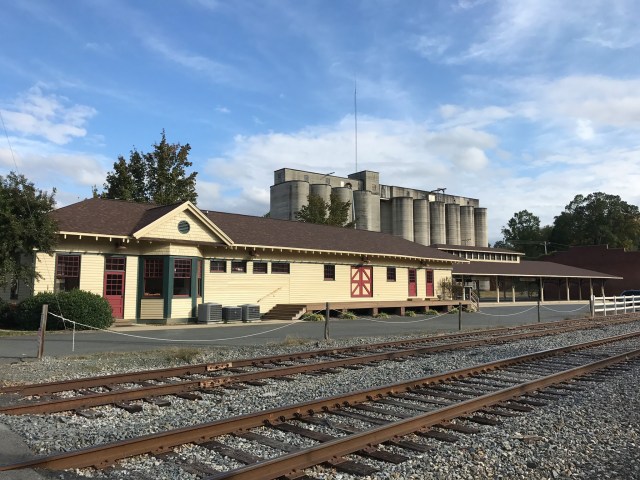
Rice came to Badin as a young engineer in the town’s first years and never forgot the ride in: a little train rocking along a canal bank, past Palmer Mountain and a hillside of construction shacks, to a small station with a horse-drawn hack waiting. He was one of Alcoa’s earliest employees here. When Adrien Badin’s son visited in 1976, it was Rice who described the town’s French beginnings.
- At the museum
- His memoir, Recollections of Badin, is sold by the museum.
- Read more
- His arrival, in the museum’s depot history
Herbert Doerschuk
The engineer who looked down
Doerschuk was an Alcoa chemical engineer and an amateur archaeologist. On walks in the woods above the dam he kept picking up stone points and tools, and he understood what they meant. In 1938, the museum says, he brought the place to the attention of Joffre Coe of the University of North Carolina. The Hardaway Site, named for the construction company that had camped there, turned out to hold one of the oldest and most important records of human life in the eastern United States.
- At the museum
- The Hardaway exhibit in the main building
- Read more
- The Hardaway Site, on the Guide
The volunteers
Badin Museum Volunteers and Friends
The museum describes itself as a strictly volunteer organization. Better Badin and Friends of Badin raised the money to move the first building. Volunteers built the firehouse in 2004 and gave two years of sweat labor to the quadruplex. Neighbors answered the call for furniture, dishes and photographs. The same kind of people guide the tours today, and they are always looking for help.
- Join them
- How to volunteer
- Or call
- 704-422-6900
Three lives against the town’s timeline
Davis was already 46 when the French broke ground. Palmer and Donaldson were both children of the company town he bought.
The town that shaped them


Donaldson once described his hometown in a single line: a place where nearly everybody worked for the aluminum plant unless they were a doctor, a lawyer or a teacher. All four Donaldson children played music, and all four went to college.
From the museum’s archive: Lou Donaldson John Cornelius Palmer Arthur Vining Davis Adrien Badin
Who am I?
I gave the town my name but never saw it.
I caddied at the country club at 13 and played on the 1949 Ryder Cup team.
My mother bought my first clarinet from the Alcoa bandmaster.
I kept Old 37 from being sold and built it a firehouse.
History courtesy of the Badin Historic Museum. This page retells research and photographs the museum publishes at badin-museum.org, in the Guide’s own words, with links back to the original articles. Go see the real thing: admission is free.
See it in person
The Badin Historic Museum is at 60 Falls Road in downtown Badin. It is open Tuesdays from 9 a.m. to noon and 1 to 3 p.m., and Sundays from 2 to 5 p.m. Admission is free.
Open Tuesdays and Sundays
Sources for this chapter
- Badin Historic Museum: Adrien Badin
- Badin Historic Museum: Arthur Vining Davis
- Badin Historic Museum: Lou Donaldson
- Badin Historic Museum: John Cornelius Palmer
- Badin Historic Museum: Badin Train Depot
- Badin Historic Museum: The Hardaway Site
- Stanly News & Press: Badin honors town’s museum founder at open house (June 1, 2021)
- Wikipedia: Lou Donaldson
- Wikipedia: Johnny Palmer
- Wikipedia: Arthur Vining Davis
Photographs are from the Badin Historic Museum’s website and collection, used with credit to the museum. The Stanly County Guide is independent and is not operated by the museum. Spot an error? Tell us. Updated November 14, 2026.