Albemarle began as fifty donated acres on a ridge and a square of public ground where the county’s first courthouse stood. Nearly two centuries later it is a city of about 17,800 people, the seat of Stanly County, and the place much of the county still comes to for court, the library, a parade or a Saturday downtown. This profile covers how it got here, what survives from each chapter, and where to start if you want to see it for yourself.
| County seat since | 1841, when Stanly County was formed from Montgomery County |
|---|---|
| Incorporated | 1857 |
| Population, 2020 Census | 16,432 |
| Population, July 1, 2025 (Census Bureau estimate) | 17,769 |
| Land area | 18.2 square miles (2025 Census Gazetteer) |
| Government | Mayor and seven-member city council |
| National Register listings in the city | 9, including four historic districts |
| City Hall | 144 North Second Street, 704-984-9400 |

Fifty acres and a public square
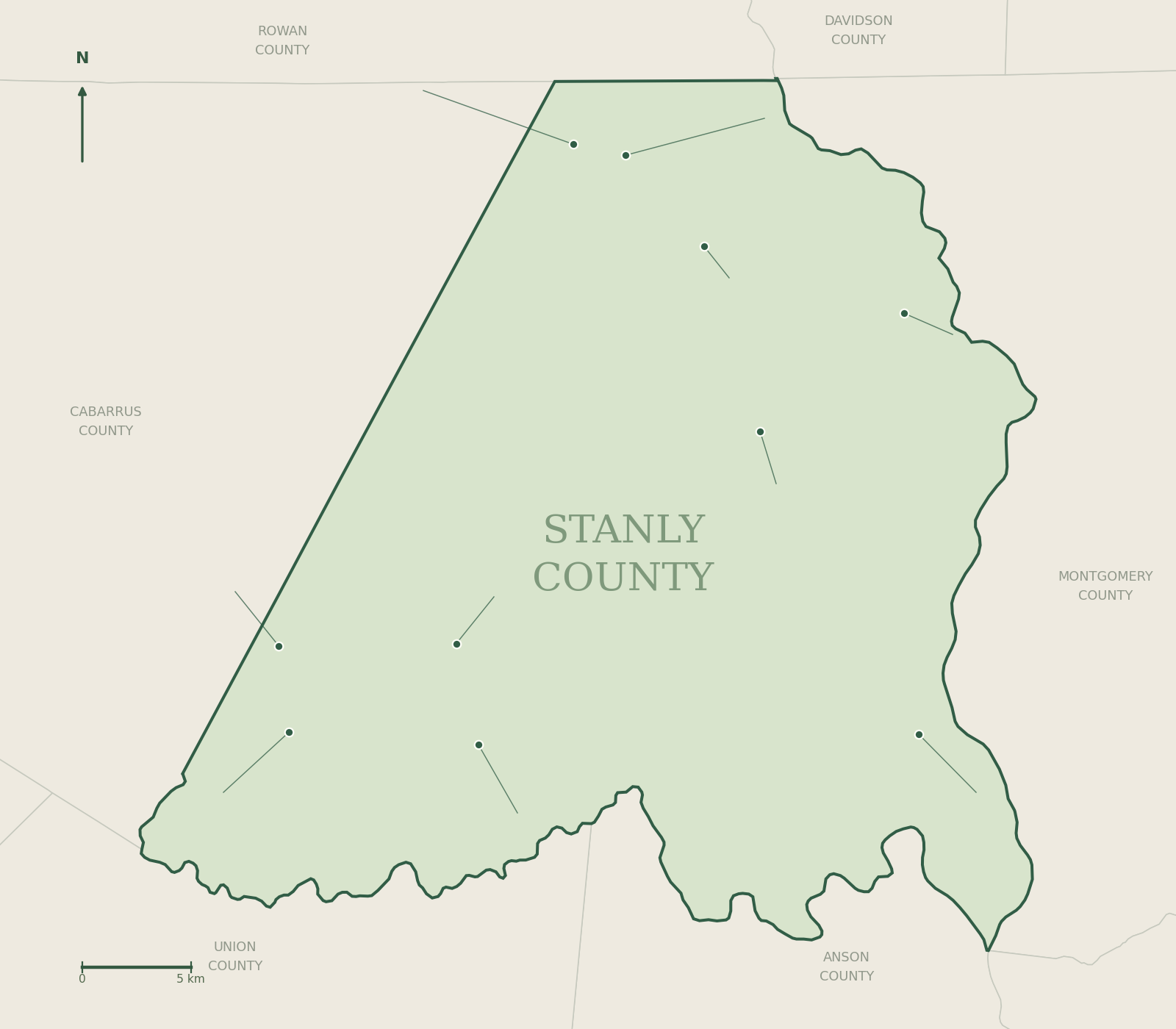
Stanly County was carved out of Montgomery County in 1841 because people living west of the Yadkin–Pee Dee River found it hard to cross the river to reach court. The new county needed a seat. Nancy Almond Hearne, the widow of Nehemiah Hearne, and her children donated 50 acres for it, according to the Stanly County Historical Society’s walking tour.
The site was not a blank slate. The federal survey of downtown for the National Register identifies Smith’s Store, opened in 1826 where the old Fayetteville–Salisbury and Raleigh–Charlotte roads crossed, as the first known settlement in what became Stanly County. George S. Smith ran the store and served as the first postmaster.
Laying out the town took some doing. The Historical Society says that in 1842, “after much debate and two lawsuits,” the new town was surveyed on the crest of a ridge southeast of Little Long Creek. The plan was six blocks bounded by First and Fourth streets and North and South streets, with a public square 100 yards on a side at Main and Second. Surveyors divided the plat into 72 lots, which were auctioned to pay for a courthouse and a jail. Until the courthouse was finished, court met at Nancy Hearne’s home.
The name looks back to North Carolina’s beginnings. The Historical Society says Albemarle was named for Albemarle County, once in the northeast corner of the state. The City of Albemarle traces it further, to George Monck, Duke of Albemarle, one of the eight Lords Proprietors granted Carolina by King Charles II in 1663.
A small town until the railroad
Albemarle incorporated in 1857, and for decades it stayed modest. The National Register nomination lists what was there at incorporation: two grog shops, a cabinet shop, the Marshall Hotel, a post office, a Methodist meeting house and seven houses, four of them log. Even in 1891 the population did not exceed 300, and there were only about six frame commercial buildings.
The Freeman-Marks House is the best survivor from that era. The Historical Society calls it the oldest structure within the original town limits. Daniel Freeman built the two-room Federal-style house on his farm about a mile out River Road, now Pee Dee Avenue, around 1835, and moved it into town about 1847. It served as a general store, law office and doctor’s office before Whitson Marks bought it in 1884. The Marks family donated it to the museum in 1975.

Its neighbor, the Isaiah and Ellen Snuggs House, dates to 1852. It started as a one-story, two-room log house. Isaiah Wilson Snuggs, a Civil War veteran and saddler, bought it in 1873 and began enlarging it around 1880. The two houses share a lot at 112 North Third Street. The Historical Society operates both, uses them for special events and opens them for tours by appointment.

Railroad, mills and a brick downtown
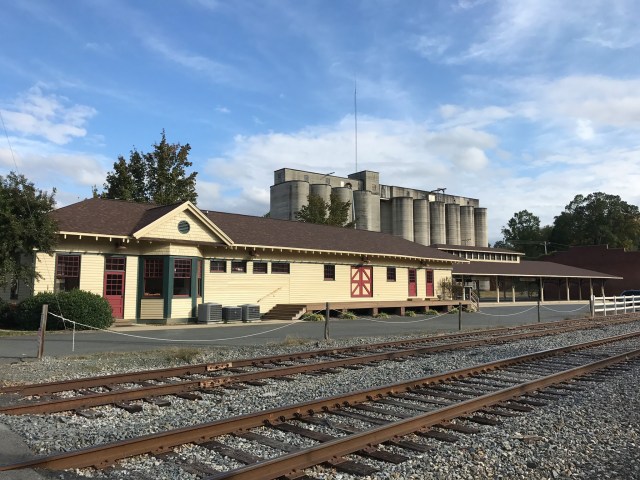
Everything changed in 1891, when the Yadkin Railroad came through on its way from Salisbury to Norwood. In 1897, the year the first passenger train reached Albemarle, Cabarrus County textile man James William Cannon and Stanly businessman Irenus Polycarp Efird opened the first Efird Manufacturing Company mill. Two years later Cannon opened Wiscassett Mills next door. The Winston-Salem Southbound Railroad added passenger and freight service in 1912.
The numbers show what followed. The National Register nomination puts Albemarle’s population at 1,382 in 1900, more than 2,100 by 1910 and 3,493 by 1930. Frame storefronts gave way to brick. When the downtown district was documented in 2002, nine buildings from 1898 still stood on the west side of South Second Street, five of them built by physician and developer Dr. O. D. King. A fire in December 1899 burned the Freeman Hotel and most of its block, and the brick Central Hotel replaced it in 1900.

The mills made Albemarle a textile town, and the City says it stayed one until the 1980s and 1990s, when the economy diversified. That story gets its own County Journal profile later in this series.
Landmarks on the old square
The best way to see Albemarle’s history is on foot. The Historical Society’s walking tour is a 1.1-mile loop that starts at the Stanly County History Center, 157 North Second Street. Built for Lefler Furniture Company in the 1950s and later used as a city hall annex, the building reopened as the History Center on April 3, 2017. It now houses the Stanly County Museum and the Heritage Room.

The courthouse corner
The first courthouse stood in the middle of the square. The county’s second courthouse, a tall Victorian building with a cupola, went up in 1893 on the northeast corner of Main and Second and was torn down in 1973. The present Stanly County Courthouse was completed in 1972 on the site of the old Freeman Hotel and Central Hotel. Courthouse Square Park, dedicated in 1996, keeps part of the original public ground open. Its clock once hung on the Cabarrus Bank and Trust building at West Main and North First streets.


The Opera House and the Alameda
On West Main Street, the Starnes-Parker Building was completed in 1908 with storefronts below and an opera house upstairs. The hall hosted lectures, revivals, plays, concerts and some of the town’s first motion pictures. Starnes Jewelers, founded in 1898, is the oldest retail business in continuous operation in Stanly County, according to the Historical Society. In 1936 the storefront got the black Carrara glass front that the National Register nomination now treats as significant in its own right. The Alameda Theatre, built in 1916 on North Second Street, was the town’s first modern movie house and largely ended the opera house’s run as a performance hall.
Churches that anchor the blocks
Methodists have worshiped on the Central United Methodist Church site on North Second Street since at least 1852, which makes it Albemarle’s oldest congregation, according to the Historical Society. Daniel Freeman donated the land, and work on the present Gothic Revival church began in 1908. First Lutheran’s 1908 sanctuary on South Second Street was the first brick sanctuary completed in town. First Presbyterian’s current church dates to 1924, and First Baptist began its Beaux Arts building in 1916.

Albemarle on the National Register
Nine Albemarle properties are listed on the National Register of Historic Places, according to the State Historic Preservation Office:
- Downtown Albemarle Historic District (2002)
- Pee Dee Avenue Historic District (1998)
- Five Points Historic District (2002)
- Second Street Historic District (2005)
- Opera House/Starnes Jewelers Building (1995)
- Isaiah Wilson Snuggs House and Marks House (1995)
- Albemarle Graded School–Central Elementary School (2014)
- Thomas Marcellus Denning House (2011)
- Julius Clegg Hall House (2021)
The residential districts and the mill neighborhood at Five Points are covered in more depth later in this series.
Albemarle today
The city is governed by a mayor and a seven-member council, according to the City of Albemarle. It runs its own electric system, started in 1910, along with water, sewer and a parks department.

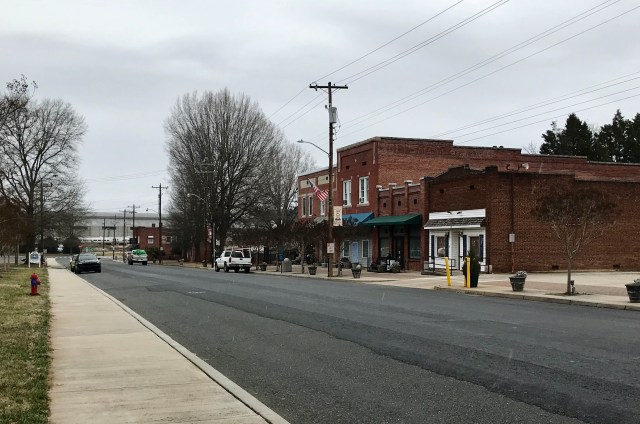
Downtown has come back from hard years. The National Register nomination describes how Quenby Mall, opened in 1960, pulled retail out of the center of town, and how the decline of textiles made things worse. Since the mid-1990s, rehabilitation has brought many of the old buildings back into use. The Albemarle Downtown Development Corporation runs a designated North Carolina Main Street program that is also Main Street America Accredited. Restaurants, shops, theater, art walks and street festivals keep the blocks around the square busy.

Things to do in Albemarle
- Walk the Historical Society’s 1.1-mile downtown tour, starting at the History Center at 157 North Second Street.
- See the Snuggs House and the Freeman-Marks House on North Third Street. The Historical Society opens them for tours by appointment and for events such as living-history days and quilt shows.
- Browse downtown’s restaurants and shops. The Albemarle restaurant guide lists them.
- Drive out to Morrow Mountain State Park. Its mailing address is 49104 Morrow Mountain Road, Albemarle, and it has summit views, trails, Lake Tillery shoreline and, according to NC State Parks, the state park system’s only day-use swimming pool, built by the Civilian Conservation Corps.
- Read the stories of Albemarle’s 1940 American Legion national champions and the railroad bonds Stanly County took to the U.S. Supreme Court.
- Check the events calendar for parades, concerts and festivals.
Keep exploring
For directions, contacts and schools, see the Albemarle town guide. For a timeline, see the History of Albemarle. The historical markers guide maps every marker in town.
Sources
- Stanly County Historical Society, Historical Walking Tour of Downtown Albemarle
- National Register nomination, Downtown Albemarle Historic District (NC State Historic Preservation Office, PDF)
- City of Albemarle, History
- NC State Historic Preservation Office, National Register listings
- Stanly County Historical Society, Historic Houses
- Albemarle Downtown Development Corporation
- NC State Parks, Morrow Mountain State Park
- U.S. Census Bureau, 2020 Census Redistricting Data (P.L. 94-171), North Carolina
- U.S. Census Bureau, Vintage 2025 city and town population estimates, North Carolina (CSV)
- U.S. Census Bureau, 2025 Gazetteer, North Carolina places