The Summer Albemarle Won It All
In September 1940 a team of Albemarle teenagers lost the first two games of the American Legion national finals, then won three straight. The record book counts 13,500 people at the last game.
In the first week of September 1940, a ballpark in Albemarle held a crowd equal to about four in every ten people in Stanly County. The American Legion’s record book puts it at 13,500. They had come to see the fifth and deciding game of the Legion’s national junior baseball championship, known then as the Little World Series or Junior World Series, between Albemarle Post 76 and San Diego Post 6. Albemarle won, 9 to 8, and became the national champion.
The title is one of the proudest moments in Stanly County sports. It also has a harder side that belongs in any honest account. Two of San Diego’s best players, John Ritchey and Nelson Manuel, were Black, and they were not allowed to play in Albemarle. This article sets out what the surviving records show about the series, the team and the crowd, and it is plain about the points where the records are thin or disagree.
Legion ball in a mill town
American Legion Junior Baseball began in 1925 as a program for teenage boys sponsored by local posts of the veterans’ organization, and its national tournament quickly became the most important amateur championship a small-town team could chase. North Carolina took to it early. Raleigh’s Post 1 won the state’s first title in 1929 and hosted the first national-tournament round held in the state, and Gastonia’s Post 23 won the national championship on its own field in 1935.
The program was already sending Carolina boys to the major leagues. J. K. “Buddy” Lewis, a Gastonia Legion product, reached the Washington Senators on September 16, 1935. Lawrence “Crash” Davis, another North Carolina Legion alumnus, whose name was later borrowed for the film Bull Durham, was playing for the Philadelphia Athletics in the summer of 1940. For a teenager in a Piedmont mill town, the Legion team was the visible first step toward a professional contract.
Albemarle in 1940 was a textile town at the center of a county of 32,834 people. Cotton mills, Wiscassett and Efird among them, shaped its economy, and baseball was part of the weekly routine. A ticket in the Stanly County Museum collection admits its holder to Wiscassett Baseball Park on August 31, 1921, nineteen years before the Legion team’s run. The boys who played for Walter B. Hill Post 76 in 1940 grew up in that setting. Seven of them were still students at Albemarle High School when classes resumed that fall, according to the school newspaper, The Full Moon.


The road to the finals
Legion tournaments in 1940 were a ladder. A team had to win its state, then a regional, then a sectional, before it reached the national finals, and a single bad series ended the season. The complete game-by-game record of Albemarle’s climb is best followed in the newspapers of that summer, which are held on microfilm and in the Stanly County Museum’s scrapbooks. Two surviving items mark the upper rungs.
The first is a recollection. Tony E. Morris of Troy, a former athletic officer of Post 76 and area commissioner for Legion baseball, wrote in the Stanly News & Press in 2021 that Albemarle won its regional at Gastonia. The second is a piece of cardboard. The museum holds a reserved-seat ticket, price 75 cents, for the “American Legion Junior Baseball Sectional Finals” at Hayman Park in Charlotte on Monday evening, August 26, 1940. The official program for the national finals in Albemarle is dated from September 3, eight days later.
The other finalist came a long way. San Diego Post 6, coached by Mike Morrow, had won the national title in 1938 by beating Spartanburg, South Carolina, in Spartanburg. In 1940 the Californians won their sectional at Shelby, North Carolina, against a team from St. Louis, and then traveled about 75 miles east to Albemarle.
Post 6 was a formidable program. Its 1938 champions went through their regular season unbeaten and reached the finals by beating a Detroit team led by Hal Newhouser, a future member of the Baseball Hall of Fame, in a semifinal series at Charlotte. In the deciding game of that series San Diego scored twice off Newhouser and ended a streak the Charlotte Observer counted at 65 consecutive scoreless innings. Several of Morrow’s players of those years, among them pitchers Chet Kehn and Duane Pillette, later reached the major leagues. The team that came to Albemarle in 1940 was used to winning in the Carolinas.
A ballpark in a week
Hosting the finals created a practical problem. In the same 2021 account, Morris wrote that after the regional Albemarle had no field fit for a national series, that Dr. Shaver and Ren Lefler offered a site, and that the community built a ballpark in seven days. We have not found a period document that gives the construction schedule, so the seven-day figure rests on that later account. What is certain is that within a few days of the sectional the town was able to seat crowds in five figures.
The Legion printed an Official Souvenir Program and Box Score for the series, dated September 3 to 7, 1940, and a copy is preserved in the Stanly County Museum and digitized by DigitalNC. The museum also holds a scrapbook of newspaper coverage and a team photograph with every player identified.
Five games, one run
The series was best of five. San Diego won the first two games, which left Albemarle one loss from elimination with three still to play. Albemarle won the third game, then the fourth, and the series came down to a single game.
The fifth game was as close as the series. Albemarle led 9 to 8 at the end, and San Diego had a runner in position to tie it. The Legion’s own history of the tournament describes the last play: San Diego tried a squeeze bunt, Albemarle catcher Hoyle Boger called for a pitchout, and the runner was retired for the final out. Over the five games Albemarle scored 26 runs and San Diego 24.
For readers who do not follow baseball closely, the last play deserves a word. On a squeeze, the runner on third base breaks for home as the pitch is thrown and the batter bunts the ball to give him time to score. It works only if the batter can reach the pitch. A pitchout is the defense’s answer: the catcher calls for a ball thrown deliberately wide, where the batter cannot bunt it, and the runner is caught between bases. It is a guess, and a wrong guess costs a ball in the count. Boger guessed right with a national championship at stake.
San Diego takes a 2–0 lead
The visitors from California, national champions two years earlier, won the first two games in Albemarle. One more win would have given them a second title.
Albemarle stays alive
Facing elimination, Post 76 won the third game and cut the series deficit to two games to one.
The series is tied
Albemarle won again. After four games each team had two wins and the championship would be decided in one game.
Albemarle 9, San Diego 8
With the tying run threatening, San Diego tried a squeeze play. Catcher Hoyle Boger called a pitchout and the runner was put out to end the game and the series.
The Legion’s record book lists the crowd at 13,500.
Albemarle second baseman and pitcher Clyde Dick finished the national tournament with a .452 batting average. The Legion’s records list him as the 1940 winner of its award for the highest average in national competition.
The players who could not play
San Diego did not field its full team in Albemarle. John Ritchey, a 17-year-old catcher, and Nelson Manuel were regulars for Post 6 and were Black. Researchers who have studied Ritchey’s career agree on the outline of what happened and differ somewhat on who gave the order.
It had happened before. In 1938, when San Diego won the national title in Spartanburg, Ritchey and Manuel were kept out of the finals. Amy Essington, a historian of the integration of the Pacific Coast League, writes that Spartanburg did not allow Black and white players on the same field. In 1940, according to the Society for American Baseball Research biography of Ritchey, the two were allowed to play in the sectional at Shelby, where Ritchey’s double won a game, and a Black newspaper in Los Angeles, the California Eagle, called it a history-making event.
Albemarle was different. The SABR biography says local authorities cited Jim Crow laws and barred the two players. Essington’s account says Legion officials asked that they be kept on the bench. Tom Shanahan, writing for Voice of San Diego in 2008, reported that coach Morrow had been given assurances before the trip that 1938 would not be repeated, that Ritchey and Manuel watched the finals from the dugout, and that Charlotte Observer sportswriter Jake Wade described boos directed at the two during warmups. Ritchey later said that local people watched him hit line drives over the fence in batting practice and then decided to enforce the rule.
Ritchey had been San Diego’s leading hitter, at .389 by SABR’s account. Without him and Manuel, San Diego lost a series decided by two runs over five games. The national Black press noticed. Wendell Smith of the Pittsburgh Courier criticized the Legion for calling such treatment Americanism, and the Norfolk Journal and Guide put the result on its front page.
None of this was the doing of the Albemarle players, who were teenagers and won the games that were played. But the 1940 championship cannot be described accurately without it. John Ritchey went on to serve as an Army engineer staff sergeant in Europe during World War II, to win the Negro American League batting title with the Chicago American Giants in 1947, and on March 30, 1948 to become the first Black player in the Pacific Coast League, with his hometown San Diego Padres. A bust of him was unveiled at Petco Park in 2005. He died in 2003.
Counting the crowd
Two figures circulate for the last game. The American Legion’s World Series record book lists attendance at the 1940 final as 13,500 and the total for the five games as 42,500. Morris, and Shanahan after him, give the final-game crowd as about 12,500, and Morris called it a record for an amateur baseball game. Either figure is remarkable for the place. Stanly County’s entire population in the 1940 census was 32,834. The final game alone drew a crowd equal to about four in ten of the county’s residents, and the five-game total was larger than the county.
The 1940 roster
The Stanly County Museum’s team photograph, digitized by DigitalNC, identifies the champions by row and position. The caption spells the coach’s name Porter Sheppard; the 2021 newspaper account spells it Shepherd. One person in the back row is identified only as Frank.
| Name | Position | Row in photo |
|---|---|---|
| Clyde Dick | Second base and pitcher | Third |
| J. W. “Lefty” Lisk | Pitcher | Second |
| Tommy Swanner | Pitcher | Front |
| Hoyle Boger | Catcher | Second |
| Bill Long | Catcher and utility | Second |
| John Little | First base | Third |
| Junior Holt | Shortstop | Third |
| Sam Andrew | Third base | Third |
| Clyde Hartsell | Left field | Front |
| Craig Lisk | Center field | Front |
| James McCarnes | Right field | Second |
| Sherrill Cranford | Utility | Front |
| Tommy Rabe | Utility | Front |
| Porter Sheppard | Coach | Third |
| Frank Little | Bat boy | Second |
| Frank (surname not recorded) | Not recorded | Third |
Boger, whose pitchout ended the series, signed with the Chicago White Sox organization in 1942 and spent eight seasons in the minor leagues with White Sox and Cleveland Indians farm clubs, according to the Legion’s history.
What came afterward
Albemarle stayed on the Legion map for a few more years. The city hosted regional tournaments in 1941 and 1944. Shelby’s Post 82 became the third North Carolina team to win the national title in 1945, in a series played at Griffith Park in Charlotte, and Shelby has been the permanent home of the American Legion World Series since 2011.
The world the 1940 team played in changed quickly. Within days of the final game, on September 16, 1940, President Franklin D. Roosevelt signed the Selective Training and Service Act, the first peacetime draft in American history. The Legionnaires who sponsored the team were veterans of the First World War, and many of the boys on the field would be of military age before the next one ended.
| Year | Champion | Finals played at |
|---|---|---|
| 1935 | Gastonia Post 23 | Gastonia |
| 1940 | Albemarle Post 76 | Albemarle |
| 1945 | Shelby Post 82 | Charlotte (Griffith Park) |
Minor league baseball came briefly in 1948, when the Albemarle Rockets of the Class D North Carolina State League played a single season at Morton Park, a ballpark built east of town in 1947. The Rockets finished last, with 32 wins and 78 losses, and drew 28,025 paying customers over the whole season, well short of the 42,500 the Legion record book counts for the five games of September 1940. Legion teams used Morton Park into the 1960s. Then the program lapsed. By Morris’s account Stanly County had no Legion team from 1962 until about 1985, when a local committee raised $24,000 to bring it back. In 2021 the county again went without a team for lack of eligible players, most of whom were playing travel ball.
The 1940 championship is remembered in the Stanly County Museum’s collections in Albemarle, which include the souvenir program, the sectional ticket, the team photograph and the scrapbook. The museum and the other history sites in the county are the place to start for anyone tracing a relative on the team. For the town the boys grew up in, see our history of Albemarle and complete history of Stanly County.
Anyone who wants the full play-by-play can reconstruct it. The souvenir program was printed with a box score, and the Albemarle and Charlotte newspapers covered the series. DigitalNC, the statewide digitization project based at the University of North Carolina, hosts the museum’s program, photograph and scrapbook free online, and our guide to researching Stanly County history lists where the local newspapers can be read on microfilm.
Story versus record
Quick quiz: the 1940 champions
How did the 1940 series begin?
How did the final game end?
Who led the national tournament in batting?
Questions and answers
When did Albemarle win the American Legion national championship?
Albemarle Post 76 won the American Legion junior baseball national finals, played in Albemarle in the first week of September 1940 (the official program is dated September 3 to 7), by beating San Diego Post 6 three games to two.
What was the score of the final game?
Albemarle won the fifth and deciding game 9 to 8. The game ended when Albemarle catcher Hoyle Boger called a pitchout on a San Diego squeeze play.
How many people attended the 1940 finals in Albemarle?
The American Legion record book lists 13,500 at the final game and 42,500 for the five games. Other accounts give about 12,500 for the final. Stanly County had 32,834 residents in the 1940 census.
Who were John Ritchey and Nelson Manuel?
They were Black players and regulars for San Diego Post 6 who were not allowed to play in the 1940 finals in Albemarle. Ritchey later won a Negro American League batting title and in 1948 became the first Black player in the Pacific Coast League.
Where can I see items from the 1940 team?
The Stanly County Museum in Albemarle holds the official souvenir program, a sectional finals ticket, a scrapbook and the team photograph. Several are digitized on DigitalNC.
Sources
- American Legion, American Legion World Series Media Guide and Record Book (2022): 1940 entry (champion, runner-up, final score, attendance) and batting award list.
- Richard Walker, “Picking the best of the ALWS, part 2,” American Legion, June 2020; “North Carolina’s first American Legion World Series,” December 29, 2021; “American Legion Baseball’s historic ties to North Carolina,” January 13, 2021.
- DigitalNC, Stanly County Museum: team photograph (record 4728); Official Souvenir Program and Box Score, September 3–7, 1940 (record 21507); scrapbook of series coverage (record 106413).
- Ticket, American Legion Junior Baseball Sectional Finals, Hayman Park, Charlotte, August 26, 1940, Stanly County Museum via Digital Public Library of America.
- Society for American Baseball Research, “John Ritchey” (SABR Biography Project), citing the California Eagle, September 5 and 12, 1940; the Norfolk Journal and Guide, September 14, 1940; the Pittsburgh Courier, September 21, 1940; and Bill Swank, Echoes from Lane Field.
- Tom Shanahan, “Johnny Ritchey’s Silent Protest,” Voice of San Diego, June 17, 2008.
- Amy Essington, The Integration of the Pacific Coast League: Race and Baseball on the West Coast (University of Nebraska Press), as cited in “Johnny Ritchey,” Wikipedia.
- Tony E. Morris, letter to the editor, “What happened to American Legion Baseball in Stanly County?” Stanly News & Press, June 25, 2021.
- The Full Moon (Albemarle High School), September 27, 1940, via DigitalNC; “Albemarle Rockets,” Wikipedia, citing the Stanly News & Press, October 17, 2019.
- U.S. Census Bureau, Sixteenth Census (1940), population of Stanly County, North Carolina.
The individual scores of Games 1 through 4, the pitchers of record and the story of the state and regional rounds are in the 1940 newspapers. If you have clippings, a program or family memories of the series, the Stanly County Guide would like to add them. Reach us through the About page.
Local businesses, churches and nonprofits can sponsor history features like this one.
Photo and image credits (8)
Ticket to the American Legion Junior Baseball Sectional Finals, Charlotte, August 26, 1940 — Stanly County Museum via Digital Public Library of America / Wikimedia Commons, public domain
Ticket to Wiscassett Baseball Park, Albemarle, August 31, 1921 — Stanly County Museum via Digital Public Library of America / Wikimedia Commons, public domain
Wiscassett Mills, Albemarle, 1917 — Unknown photographer, 1917 / Wikimedia Commons, public domain
Photographs of Albemarle from a Chamber of Commerce brochure, circa 1933 to 1943 — Albemarle Chamber of Commerce / Stanly County Museum via Digital Public Library of America / Wikimedia Commons, public domain
Albemarle Chamber of Commerce brochure page, circa 1933 to 1943 — Albemarle Chamber of Commerce / Stanly County Museum via Digital Public Library of America / Wikimedia Commons, public domain
Albemarle Chamber of Commerce promotional sheet, 1940s — Albemarle Chamber of Commerce / Stanly County Museum via Digital Public Library of America / Wikimedia Commons, public domain
Stanly County Court House on a 1923 postcard — Stanly County Museum via Digital Public Library of America / Wikimedia Commons, public domain
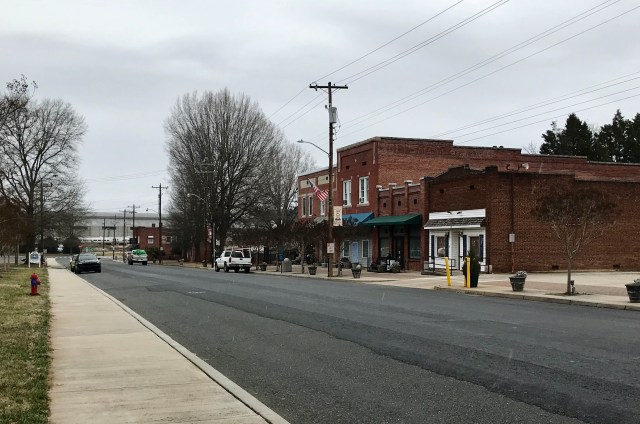
Downtown Albemarle historic district — Wikimedia Commons contributor, via the Stanly County Guide media library
Charts, tables, timelines and map overlays: original work by The Stanly County Guide. Basemap tiles © Esri and data partners.