For most of the twentieth century, a job in Albemarle very often meant a job in a mill. The City of Albemarle says its growth in the late 1800s and early 1900s “was powered by large textile mills,” and that it remained largely a textile town until the 1980s and 1990s. Three companies did most of that work: Efird Manufacturing, Wiscassett Mills and the smaller Lillian Knitting Mills. Their buildings, the houses of the people who ran them, and the schools and stores they built for workers still explain a good deal of how the city looks today.
| Railroad arrives | 1891, the Yadkin Railroad |
|---|---|
| Efird Manufacturing Company | Organized 1896; first mill opened 1897 |
| Wiscassett Mills | Incorporated 1898; in operation 1899 |
| Lillian Knitting Mills | Founded May 1905; mill completed late 1905 |
| Albemarle population | 1,382 (1900); 3,493 (1930) |
| Lillian mill at its peak, 1940 | 320 employees, 179 knitting machines |
| Five Points Historic District | National Register, October 16, 2002 |

The railroad comes, and the mills follow
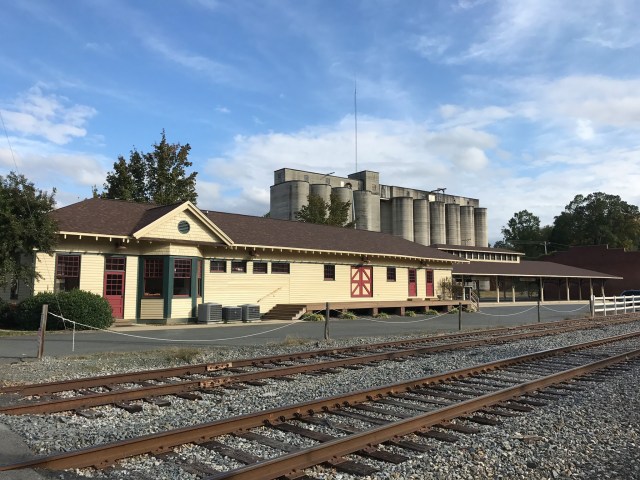
Albemarle was incorporated in 1857, but it stayed small until the Yadkin Railroad reached town in 1891. The National Register nomination for downtown Albemarle credits the railroad with “the formation of prosperous industries,” and the first of them came fast.
The money and the know-how came largely from Concord. James William Cannon, the Cabarrus County textile builder, joined with the Efird family of Stanly County to start the Efird Manufacturing Company. The nominations for downtown and for Five Points name John S. Efird and his father, Irenus Polycarp Efird, as the local partners. The company was organized in 1896 and opened its first mill in 1897, the same year the first passenger train rolled into Albemarle.
Two years later Cannon opened Wiscassett Mills on property next to the Efird complex. Wiscassett was incorporated in 1898 and began running in 1899. Its long-time superintendent later recalled that it started small: 200 employees on two shifts, 34 cards and 12,000 spindles. An expansion program soon added three more units.
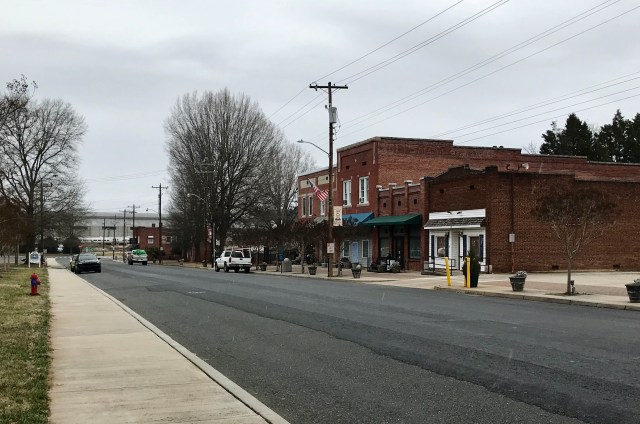
The new payrolls reshaped the town. Albemarle had 1,382 residents in 1900 and more than 2,100 by 1910. Brick stores replaced the old frame buildings downtown, and planing mills, a roller mill and a furniture factory opened in the same years.
The Big Store
The mills reached into daily life well beyond the factory floor. In 1898 Efird and Wiscassett opened a company store for their employees in a two-story building at 103 North First Street. A local newspaper advertisement that year called it “The Big Store.”
The mills ran it until 1903, when Morrow Brothers and Heath took over the space. Lowder Hardware moved in in 1932 and stayed until 1995. The building was restored, and a restaurant opened there in 1998. Look for the four-tile star motifs set into the stucco front; they are the building’s signature detail.
Mill schools
In 1923, Albemarle’s public graded school was not the only place a child in town could learn to read. According to the National Register nomination for Albemarle Graded School, Efird Manufacturing and Wiscassett Mills each ran schools for between 500 and 600 of their employees’ children that year.
Charlotte architect Louis H. Asbury designed an Efird and Wiscassett Mills school in 1912, his only known school building in Stanly County. When the city school system took over the two mill schools at the start of the 1933–34 school year, Wiscassett School was a fourteen-classroom brick building from 1912 with 509 students in grades one through seven, and Efird School, built in 1916, had twelve classrooms and 516 students. Neither survives. Efird School was demolished after North Elementary replaced it, and Wiscassett School burned and was razed; a YMCA was built on its site.

Captain Denning’s sixty years
On March 12, 1900, Thomas Marcellus Denning arrived in Albemarle to run Wiscassett Mills. He was 30 and had been in the business for two decades. His career began at age ten, in 1880, in the Carolina Cotton Mill in Alamance County; by about 1884 he was at Durham Cotton Mills, where he rose through the ranks to a management job before the general superintendent of Cannon Manufacturing Company offered him the Wiscassett post.
He stayed for sixty years, retiring as general superintendent in March 1960 at the age of ninety. His National Register nomination notes that he was addressed as “Captain,” and his 1962 obituary in the Stanly News and Press called him “Albemarle’s ‘grand old man of the textile industry.’” The paper credited him with the “high quality reputation built up for Wiscassett yarn.”
In 1924 Denning had Louis Asbury design him a Spanish Colonial Revival brick house at 415 North Second Street, with green-tiled pent cornices over the house, its porches and its porte cochere. It faces Cannon Memorial Park, stayed in the family until 2006, and was listed on the National Register in 2011. It is a private residence.

Lillian Knitting Mills: hosiery and an inventor’s patent
The third company grew out of an invention. A.L. Patterson, superintendent of Albemarle’s Windemere Knitting Mills, patented an electric “stop motion” attachment for circular knitting machines in 1901. Windemere had opened in 1899 and merged with Wiscassett in 1903. In May 1905, the same year Wiscassett built its Mill No. 2 for ladies’ seamless hosiery, Patterson incorporated his own company and named it for his wife, Lillian.
The founders of the other two mills backed him. J.W. Cannon and J.S. Efird were stockholders, R.A. Crowell was president and Patterson was secretary-treasurer. The announced plan was ambitious: a modern building with steam heat, fire protection and electric lights, and 100 knitting machines making 500 dozen pairs of hosiery a day. Concord contractor R.A. Brown, who had built Wiscassett’s second mill, finished the Lillian mill late in 1905 in what was then called East Albemarle, away from the rail lines where the other mills stood. Its crenellated four-stage tower, which held the sprinkler system’s water tank, matched the tower at Wiscassett Mill No. 2.

The start was more modest than the announcement. A June 1906 trade journal reported 56 machines. But the mill grew. A photograph from about 1910 shows 46 employees in front of the building, including six young girls and five boys, a reminder of how young some mill workers were in those years.
By 1938 Patterson said production was the highest it had ever been, requiring round-the-clock operation. That year the company added a wing for new full-fashioned knitting machines and turned the triangle of land south of the mill into a small park with a native stone wall, benches and a fountain fed by overflow from the mill’s humidifying system. In 1940 Lillian had 320 employees running 150 seamless hosiery machines and 29 full-fashioned machines, with a weekly capacity of 3,500 dozen pairs of seamless hosiery and 4,000 dozen pairs of full-fashioned silk hosiery.
The Pattersons stopped operating in the mid-1950s and the mill was auctioned; a representative of Wiscassett was the high bidder. A sportswear maker, Wear Knitsters, later occupied the building until 1992. Plant manager Donald Frye bought that business and ran it as NC Knits until 1994. Bed linen and clothing manufacturers used the building through 1998.

Five Points grows up around the mill
The low ground just below the Lillian mill, where East Main Street, Pee Dee Avenue and Fourth Street meet, was mostly houses in the early 1910s. A creek ran through it, but by 1912, when the city waterworks opened, it had been channeled underground. In 1922 the corner was transformed by new masonry buildings, many of them serving the automobile: a granite-walled Dodge dealership built for the Auten-Wolfe Motor Company, which became the Morgan family’s Pontiac dealership from 1926 to 1991; a Chrysler dealership and garage; Model Tailoring Company’s dry cleaning plant; Anderson Grocery; and a filling station. By the end of the 1920s the district was fully built.
The Five Points Historic District, listed on the National Register on October 16, 2002, keeps that group together. Its nomination calls Lillian the smallest of Albemarle’s textile factories but the most intact, with both original frame roof monitors and almost all of its large sash windows still in place. The upper stories of the tower came down in 1959 and a 1970s addition hides the bottom story of the west side, but the two early wings and the 1940s addition remain remarkably intact.

Mergers, decline and a second life
Albemarle’s big mills held up through the Depression and grew after it. In 1930 the city had 3,493 people, about twelve percent of Stanly County’s 33,216. When Cannon’s son Charles A. Cannon consolidated eight family-controlled mills into Cannon Mills Company in 1928, Efird and Wiscassett stayed outside the merger. Majority interest in Efird was sold in 1947 to the American Yarn Processing Company, and the two merged in 1952 as American and Efird. Wiscassett stayed under Charles Cannon’s direction until he retired in 1962.
The later decades were harder. Quenby Mall opened on the edge of town in 1960 and began drawing stores out of downtown. In 1971 all three of Efird’s main mills were clad in aluminum. By 1990 Efird was a subsidiary of Fruit of the Loom, and Wiscassett, after years as a Cannon Mills division, had been reincorporated with five mills in Albemarle and two in Concord. By the late 1990s, the Five Points nomination says, only Efird and a few small operations were still running. By 2002 most of the Wiscassett buildings had been torn down, after operations ended and a 1997 flood damaged the complex.
The Lillian mill went another way. In 2008 it was redeveloped into a mixed-use building with apartments and offices, about a $6 million project that the City of Albemarle describes as the start of downtown’s revitalization.

Seeing the mill era today
- Five Points, where East Main Street, Pee Dee Avenue and Fourth Street meet, two blocks east of downtown. The Lillian mill stands at 335 East Main Street. It is private property; the best views are from the sidewalk.
- The Big Store, 103 North First Street, the 1898 company store, inside the Downtown Albemarle Historic District.
- The Denning House, 415 North Second Street, across from Cannon Memorial Park. Private; view from the street.
- Pee Dee Avenue, uphill from Five Points. The downtown nomination notes that grand houses rose along West Main Street and Pee Dee Avenue in the same boom years. Our Albemarle history page covers the wider story of the city.
- The Stanly County History Center, home of the Stanly County Museum, which contributed the Lillian stock certificate shown above to Wikimedia Commons. For family and company records, start with our research guide.

For the wider story of how mining, railroads, textiles and aluminum shaped other towns, see Gold, Railroads & Industry in Stanly County.
Sources
- National Register of Historic Places nominations, N.C. State Historic Preservation Office: Five Points Historic District (2002); Downtown Albemarle Historic District (2002); Thomas Marcellus Denning House (2011); Albemarle Graded School–Central Elementary School (2014); Julius Clegg Hall House (2021).
- N.C. State Historic Preservation Office, National Register listings.
- City of Albemarle, History and “Albemarle’s Revitalization and Future Featured in Charlotte Observer” (June 19, 2025).
- Postcards: Durwood Barbour Collection of North Carolina Postcards (P077), UNC Libraries. Stock certificate: Stanly County Museum via the North Carolina Digital Heritage Center and DPLA.