Prohibition in Stanly County
Stills, sermons, a temperance hall, a mayor’s court and a ham lunch that got away: Stanly County’s long argument with liquor, told from the original documents.
It was a Thursday afternoon in April 1923 when two lawmen walked into Albemarle with a copper still cap, some white liquor and, by their own account, one of the finest dinners of their lives. Prohibition Officers J. E. Culp of Stanly County and a Concord officer named Widenhouse had raided the Bear Creek section, “just north of the Albemarle-Stanfield highway.” They smashed a 90-gallon still that was, in the paper’s words, “cocked and primed.” The men running it had evidently gotten a “hunch” that the officers were coming. They snatched the big copper cap off the still and carried it some distance away, but Culp and Widenhouse found it in their search. In the scramble to save the cap, the owners lost “a perfectly splendid box of nice country ham and fried eggs which had just been brought them for their lunch.” The officers confiscated that too.
The story, credited to the Albemarle News-Herald, ran under the headline “Officers Culp and Widenhouse Revel in Ham Dinner, Leaving Prospective Purchasers to ‘Root Hog or Die,’” and joked that Culp would testify that no better ham had ever made his acquaintance. It is a small, human scene, and one of only a few eyewitness glimpses of Prohibition in Stanly County that survive in print. This article sets those glimpses beside something rarer: original Stanly documents. They include a whisky account from the 1840s, a temperance society’s minute book, arrest papers from the Albemarle mayor’s court, a county map from the 1920s or early 1930s, and the names of local people in the 1933 fight over repeal. The Stanly County Museum has digitized many of these papers, but they are hard to find online. Everything below is tied to a source listed at the end. Where the record is silent or conflicting, I say so.

Whisky was legal first
Stanly County did not exist until January 1841, when it was carved out of Montgomery County. The new county seat was laid out the next year, and its original plat survives: a hand-colored sheet showing a public square “for Court House, 100 yds square” and four streets of numbered lots.

Somewhere in those years, someone in northern Stanly kept a tally of whisky on the back of a schoolteacher’s contract. The Stanly County Museum catalogs the sheet as dated 1840 to 1850. One side is an agreement for David Pickler to teach English. The other carries a column of numbers headed with R. G. D. Pickler’s name and the word whisky. The museum calls it a record of whiskey “production or purchases.” The page does not say which, what the numbers measure or whom it was for, and I will not guess. It does show that whisky was ordinary enough in early Stanly to be written down on scrap paper.

By the early 1850s Albemarle had a saloon trade of its own, and an organized backlash. The Stanly County Historical Society’s downtown walking tour says G. W. Russell ran a grog shop on North Second Street from the early 1850s until late in the century. In 1852 he sold his saloon building to the Sons of Temperance on condition that it be used as a Temperance Hall. After the temperance society failed, during or shortly after the Civil War, he got the property back. Russell ran one of Albemarle’s two saloons; the other, on South Second Street, belonged to Isaac Biles and later Kearn Howell.
The museum also holds a minute book of “Montgomery Division No. 97 of the Sons of Temperance,” dated 1850 to 1852. Its catalog places that division in Montgomery County, while the walking tour separately says Albemarle’s division formed in 1852. I could not confirm that they are the same group, so I have kept the two apart. The book itself shows how seriously these societies took their paperwork: a written constitution, and a long roll of members with some names crossed out.

By the 1890s drunkenness had its own paperwork too. The museum holds a handful of papers from Albemarle’s Mayor’s Court. On March 3, 1897, W. C. Russell swore that Tom Forrest had violated a town ordinance by “going about drunk … using profane language & assaulting Harris Dennis.” On Christmas Eve 1904, Mayor J. W. Bostian ordered the jailer to hold Dave Doby, who had been “brought before me & too drunk for trial,” until a hearing on December 26 at 10:30. As far as I can read them, neither paper mentions the prohibition movement. They show the everyday trouble that movement said it wanted to end.


Stanly in the 1908 campaign
North Carolina took the long road to prohibition. The 1903 Watts Act banned making and selling liquor outside incorporated towns, and the 1905 Ward Law extended that to towns under 1,000 people, leaving 68 of the state’s 98 counties under Prohibition. Then came a statewide referendum. On May 26, 1908, voters approved statewide prohibition by 113,612 to 69,416, with 21 counties voting against, and it took effect in January 1909.
Stanly was on the dry side of the argument well before the vote. In a letter dated January 16, 1908, the Salisbury Anti-Saloon League complained to members of the legislature that Salisbury’s liquor trade was “flooding” the territory of “the adjoining dry counties and towns.” It named Iredell, Mecklenburg, Cabarrus, Stanly, Davidson, Davie and Guilford counties, and among the towns “Albermarle” (the letter’s spelling). The League printed it in a 1908 pamphlet, Recent Utterances on State Prohibition. That is a partisan source, not a count. I did not find Stanly’s actual returns for the 1908 vote. The one newspaper page that might list them, the News & Observer of May 27, 1908, is too badly garbled in its digitized text to read Stanly’s line, and I will not guess at a number.

A preacher, a sheriff and a copper cap
National Prohibition began January 17, 1920, but North Carolina had already been dry for eleven years. In August 1920 the Stanly News-Herald told readers about Rev. John Harris, “known throughout this county, Union and Anson as the Billie Sunday of Stanly County.” He was holding an outdoor revival in the northwest Albemarle section and preaching plainly: “You old crusty blind tigers who have been selling mean whiskey and damning the morals of this section must turn from your filthy and dirty work.” The meeting was held outdoors with wheat straw spread on the ground, so it was “hitting the wheat-straw trail” instead of the sawdust trail. The paper said the summer before, Harris had “preached several blockade stills out of” Anson County, with “one man having hauled his still to church where he turned it over” to him. It added that “upwards of one hundred men, women and children were on the mourner’s bench at one time.”

Two months later, on October 4, 1920, the county commissioners allowed Sheriff G. D. Blalock $20 “for capturing one still.” (The 1943 North Carolina Manual says Joshua J. Morton was sheriff of Stanly from 1920 to 1924; the proceedings name Blalock, and I have not reconciled the two.) The line sits between routine bills in the commissioners’ proceedings, which suggests that paying for a captured still was ordinary county business. Below is the county’s courthouse in those years, the cupola-topped brick building of 1893, on a postcard the museum dates to April 17, 1923, the same month as the Culp raid.


That raid is the best-documented Stanly still hunt I found. The Albemarle News-Herald reported it, and the Concord Daily Tribune reprinted the story on April 28, 1923. Culp is identified as an officer “of this county.” The paper said the still “was cut in pieces and the cap brought to Albemarle,” and it noted that the officers had seen no one at the still and had “not the remotest idea” who the owners were. The digitized text is unreliable on a few specifics: it gives the gallons of liquor as both “10” and “16,” and the Concord officer’s initials differ between sources. I have left both details out.
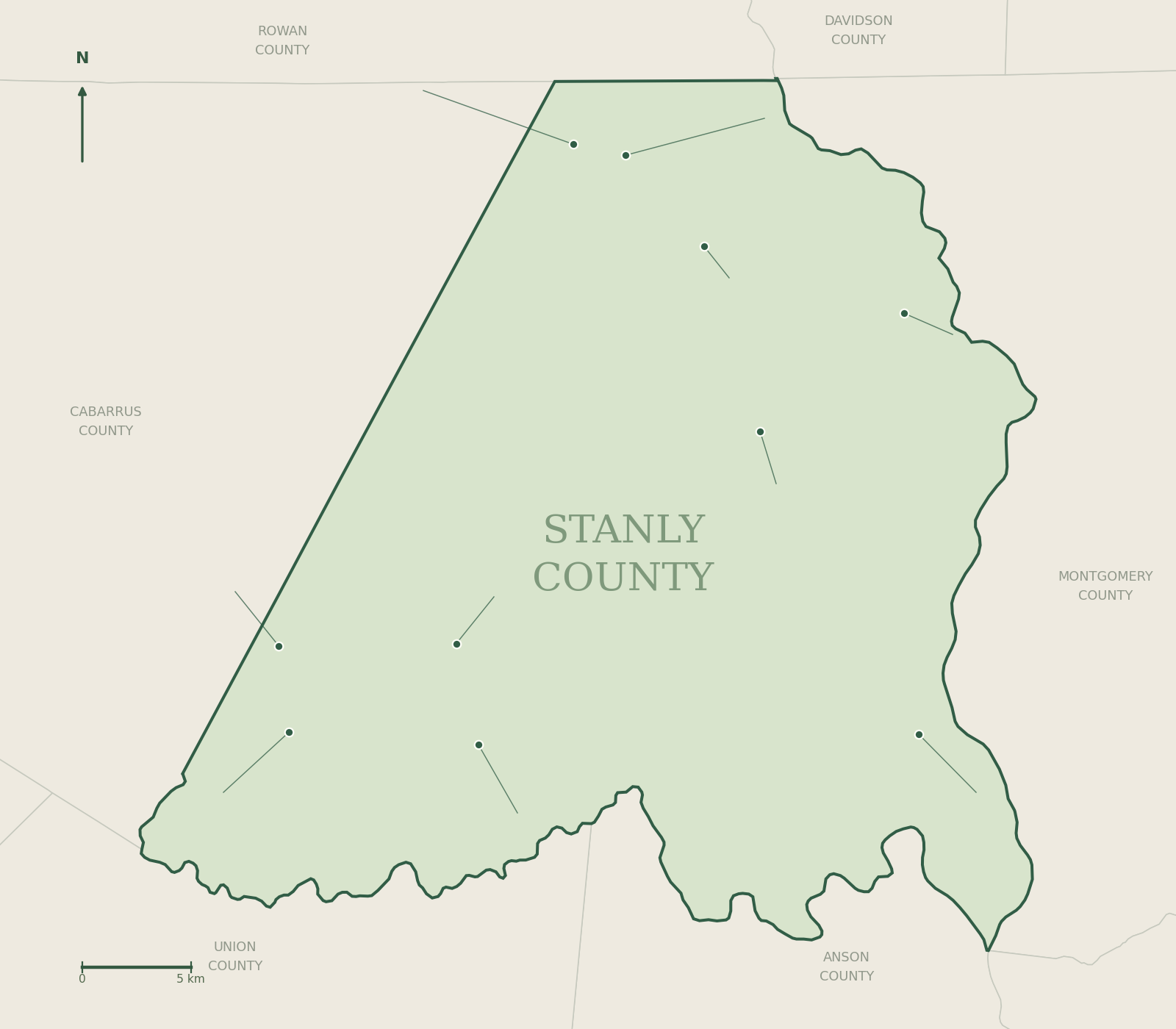
The newspaper does not say which Bear Creek it meant, so I do not pin the still on a map. The c. 1925–1935 county map by surveyor J. M. Furr Jr. does print “Bear Creek Church” just below the Almond Township label, with Stanfield, Locust, Red Cross and Big Lick to the south and west. That is the neighborhood a reader of the paper would have pictured.


I could not find a photograph of a Stanly still raid from this period. For a sense of what a seizure looked like, the State Archives of North Carolina preserves Frank Marchant’s 1909 photograph of a 100-gallon still captured by a sheriff and his deputies at Hamlet, in Richmond County. It is not Stanly. I include it only to show the equipment the officers in Culp’s story were hunting.

Stanly’s local lore has more. The Stanly County History Center’s “Murder, Mystery, and Mayhem” driving tour (by Megan Sullivan, 2020), as reported in the Stanly News Journal, includes a stop about one of the state’s largest illegal distilleries, in Norwood, and another about a shootout between officers and bootleggers in Albemarle. I looked for dated primary accounts of both and could not find them, so I am not retelling the details. If your family has them, the museum’s research room is the place to start.
Stanly’s drys at the ballot box
Repeal reached North Carolina in November 1933, and the state said no. On November 7, voters rejected a convention to consider the 21st Amendment by 293,484 to 120,190, about 29 percent in favor. Researchers note that North Carolina and South Carolina were the only two states where voters rejected pro-repeal delegate slates. The amendment itself was ratified December 5, 1933, and ended national prohibition regardless of how North Carolina voted.

The best evidence of how Stanly County took part is a pamphlet by Frances Renfrow Doak, executive secretary of the United Dry Forces of North Carolina, writing in 1934 about the campaign. Doak says her field man, Mr. Hilford, “concentrated on Anson, Richmond, Stanly,” as the group raced to have “an organization in every county by October 1st.” The pamphlet names several Stanly people.

A printed county list gives the chairman or manager for Stanly. As printed, though, the names for Stanly and Scotland are swapped: the Stanly line reads “Dr. Peter John, Laurinburg,” and the Scotland line “T. B. Mauney, Albemarle.” Laurinburg is Scotland’s county seat, and elsewhere in the pamphlet “Scotland — Dr. Peter John, Laurinburg” appears correctly, so I read T. B. Mauney of Albemarle as Stanly’s dry chairman. That is my reading of a printer’s slip, and I have said so in the caption.

The pamphlet also lists E. E. Eddins of Albemarle as Stanly’s nominee for a place on the dry slate of convention candidates, and puts Rev. F. A. Bower of Albemarle on the statewide central committee. First Baptist Church of Albemarle’s own history lists a Fred A. Bower as pastor from 1925 to 1936, which is probably the same man.


What I could not find is how Stanly’s voters themselves voted in 1933. The North Carolina Manual prints only statewide totals, and county returns I could reach were not usable. Some online summaries offer a Stanly figure; I could not trace any of them to a primary source, so I do not repeat them. If you have the official county abstract, I would be glad to see it.
From dry town to a city liquor store
After repeal, North Carolina moved slowly from prohibition to local control. NCpedia says a county-option liquor law in 1937 established the ABC system. Albemarle’s own path to a liquor store was long. In 1965 the General Assembly passed a local act, S.L. 1965-721, ratified May 28, 1965. It let Albemarle’s commissioners call an election if 15 percent of those who had voted for mayor signed a petition. If voters approved, a city board would run the stores, with 70 percent of net revenue to the city and 30 percent to Stanly County. No new vote could be held more often than every three years.
First Baptist Church’s history gives a glimpse of the fight. Dr. Elroy Lamb, its pastor from 1964 to 1973, “was Chairman of the Concerned Citizens Organization, which led to the defeat of ABC stores in Albemarle.” The church history gives no date for that vote, and I have not found the returns. The 1965 act is the likeliest legal path, but that is an inference.

The question was finally settled on February 10, 1998. Under S.L. 1979-259, which let Albemarle hold a store election on a petition of 15 percent of registered voters, Albemarle voters approved ABC stores 3,126 to 2,695 A mixed-beverage election the same day passed 3,118 to 2,675. The first retail sale took place on November 2, 1998. In 90 years the town had gone from the dry list in a Salisbury temperance letter to a city-run liquor store.


What I could not confirm
- Stanly County’s own vote totals in 1908 and 1933 were not found. Only statewide totals are given here.
- The gallons and the Concord officer’s initials in the April 1923 raid story conflict in the digitized text, so they are omitted.
- Whether the 1850–1852 Sons of Temperance book belongs to an Albemarle division is unconfirmed. Its catalog says Montgomery County.
- The Stanly and Scotland lines in the Doak county list are transposed in print. T. B. Mauney as Stanly’s chairman is my reading.
- E. E. Eddins and Rev. F. A. Bower appear in the Doak pamphlet; whether Bower is the First Baptist pastor Fred A. Bower is not confirmed.
- The date of the Albemarle ABC election that Dr. Lamb’s group is credited with defeating is unknown.
- Sheriff G. D. Blalock (1920 proceedings) and Joshua J. Morton (1943 Manual: sheriff of Stanly, 1920–1924) are not reconciled.
- The Historical Society’s walking tour gives the History Center at 157 North Second Street; one newspaper article says North Main Street. I used the Society’s own address.
- I could not obtain page scans of the Stanly newspapers from DigitalNC, so the newspaper items are typeset transcriptions, not photographs of the page. I labeled each one.
Sources
Newspapers and public records
- The Stanly News-Herald, Aug. 24, 1920, p. 1, and Oct. 8, 1920, p. 4, DigitalNC. Aug. 24 page · Oct. 8 page
- The Concord Daily Tribune, Apr. 28, 1923, p. 4, DigitalNC. Page
- North Carolina Manual, 1943 (p. 243 for the 1933 vote; the Stanly sheriff entry in the legislators’ biographies), via archive.org.
- S.L. 1965-721 (Albemarle ABC election act), N.C. General Assembly.
- NC ABC Commission, Albemarle ABC Board Performance Audit Report (2016).
- Frances Renfrow Doak, Why North Carolina Went Dry in 1933 (1934), via archive.org.
Archives and local history
- Stanly County Museum collection, via the NC Digital Heritage Center and DPLA, on Wikimedia Commons (item titles and dates in the captions).
- Stanly County Historical Society, Albemarle downtown walking tour (G. W. Russell, Temperance Hall, 1893 courthouse).
- First Baptist Church of Albemarle, church history (Fred A. Bower, 1925–1936; Dr. Elroy Lamb, 1964–1973).
- North Carolina Anti-Saloon League, Recent Utterances on State Prohibition ([1908]), “Appeal from Salisbury,” via Documenting the American South.
- Jesse Deal, “Stanly County History Center shares ‘Murder, Mystery, and Mayhem’ driving tour,” Stanly News Journal, Nov. 1, 2023.
- State Archives of North Carolina, General Negative Collection, Hamlet still photograph (Flickr 52814419131).
Statewide context
- K. Todd Johnson, “Prohibition,” NCpedia; N.C. Dept. of Natural and Cultural Resources, “North Carolina Voters Approve Prohibition”.
- 21st Amendment, Constitution Annotated, Congress.gov.
- John Dinan and Jac C. Heckelman, “Support for Repealing Prohibition,” Social Science Quarterly 95:3 (2014); Ballotpedia (1933 vote totals and percentage).
Explore the full archive of county history on stanly-county.com.
Christopher Adkins is a Huntersville attorney, mediator and author. Article and research for stanly-county.com. Images from the Stanly County Museum are public domain per Wikimedia Commons; crops from the Doak pamphlet are reproduced for commentary. If you hold an original, a photograph, or the missing vote returns, please get in touch.