Stanly County’s German Settlers
Lutheran and Reformed families came down the Great Wagon Road and settled west of the Yadkin. They left churches at Bear Creek and Long Creek, a name on the 1841 county act, and a village called Misenheimer.
Stanly County’s first settlers did not all come from the same direction. A history of Kendalls Baptist Church, published by the congregation in 2002, describes English families moving up the Pee Dee into the Fork section below Norwood, while a second stream came south from Pennsylvania into the northern and western parts of the county. That second stream was German. Its marks are still easy to find: in the Lutheran and Reformed churches of western Stanly, in family names such as Efird, Lyerly and Furr, and in a village that carries a German surname, Misenheimer.
Down the Great Wagon Road
The Encyclopedia of North Carolina (via NCpedia) explains the move. As open land in Pennsylvania grew scarce, German families went south into the Carolina backcountry, the first of them arriving by 1747. English neighbors turned their word for themselves, Deutsch, into “Dutch,” which is why so many of these people were called the “Pennsylvania Dutch.” Their churches included Lutheran and German Reformed congregations.
Their route was the Great Wagon Road, which ran from Philadelphia through the Shenandoah Valley to Salisbury and Charlotte. NCpedia says that from the 1750s “tens of thousands of German and Scotch-Irish immigrants” came into the colony along it. The Germans settled thickly in what became Rowan and Cabarrus counties. In eastern Cabarrus, Lutheran and Reformed families shared a union congregation, the Dutch Buffalo Creek Meeting House, from about 1745, according to the state’s historical marker program. Stanly’s German story grew out of those settlements. The Town of Stanfield’s county timeline dates German settlement of western Stanly to about 1750–1770.

Bear Creek, 1806
By the dates in these sources, the first German church inside today’s county lines stood at Bear Creek, at the far western edge of Stanly. The state marker program’s history of the church says that in 1806 Lutheran and Reformed families raised a log meeting house on land from Christopher Lyerly, with the Rev. George Boger as their first minister. The Lutheran synod’s 1953 history agrees on the year and on Lyerly, and adds that he was a Lutheran. At the time the site was in Montgomery County. It became part of Stanly in 1841.
An undated German-language record, translated in a 1974 history of the church by Frank K. Bostian and Bernard W. Cruse, describes the founders as families who had “settled here in North Carolina at the eastern end of Cabarrus County and western end of Montgomery County on the waters of Bear Creek and Buffalo Creek,” and who called themselves “Evangelical Lutheran and Evangelical Reformed, according to the faith of our ancestors.”
The two groups shared the church for most of the nineteenth century. When they separated, the Reformed congregation kept the old site, now Bethel Bear Creek Reformed Church. The Lutherans built New Bethel Lutheran Church about two miles east, near the old Misenheimer Springs.

Jacob Efird and the congregation at Long Creek
Farther east, Lutheran worship in Stanly began in a farmhouse. NCpedia’s biography of one of his descendants says pioneer Jacob Efird came to North Carolina from Pennsylvania about 1783. St. Martin’s Lutheran Church dates its first recorded service to 1814, when the traveling pastor David Henkel preached in Efird’s home near Little Bear Creek. For years the group was simply the “Congregation at Long Creek.” The church counts June 7, 1820 as its organization date. The congregation chose the name St. Martin’s in 1828 or 1829, and in 1830 built a log church on about 20 acres that Efird gave them. The church still stands in the same area, about halfway between Albemarle and Oakboro.
The records could not settle on how to spell Efird’s name. St. Martin’s own history gives an older form, “Ifert.” The 1841 act of the General Assembly that created Stanly County prints “Jacob Elfird.” That act names him as one of nine commissioners chosen to pick a site for the county seat within eight miles of Eben Hearne’s house. The county seat they were charged with locating became Albemarle. (Our story on how Stanly County got its name covers the 1841 act.)
Not every German family stayed Lutheran. According to the Kendalls Baptist history, John Pickler, born in 1772 in a German settlement in Rowan County, bought about 900 acres on Long Creek in 1803 and became an active Baptist. Part of that land is now the Kendalls Baptist Church property.
Flat Rock and the west
In western Stanly, near present-day Locust and Stanfield, Lutherans organized Flat Rock Church in 1834. In a deed dated 1835, Mathias Furr conveyed seven acres to Peter Pless, Ransom Shinn and David Harkey as “Elders of the Flat Rock Church for the Lutheran Body, Tennessee Synod.” The deed was not recorded until 1919, in Book 53, page 276, at the Stanly County Register of Deeds. The congregation eventually disbanded. Its cemetery remains in Locust. (See our history of Locust and history of Stanfield.)
Names on the map
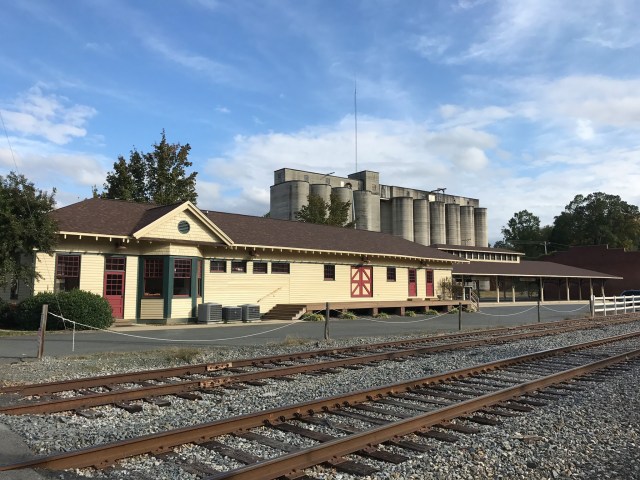
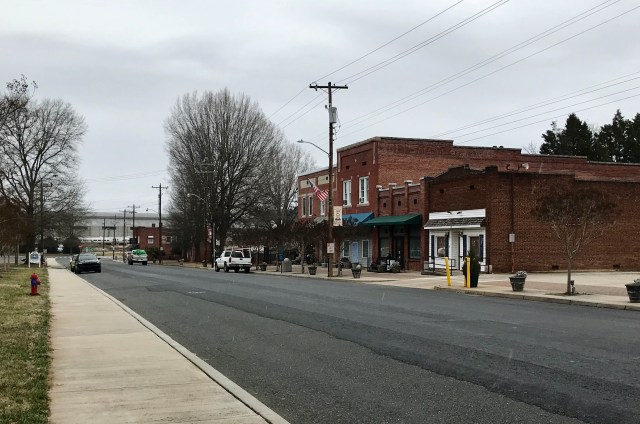
Misenheimer. In the late 1800s the community was a railroad stop called Gladstone that served a resort, Misenheimer Springs. In 1909 the community took the springs’ name so visitors would not be confused, according to the Village of Misenheimer and the North Carolina Gazetteer. Misenheimer is the Americanized form of the German surname Meisenheimer. See our Misenheimer town guide and history of Misenheimer.
Richfield. The Town of Richfield traces its origins to a late-1800s German settlement and the Ritchie family, whose sawmill, roller mill and cotton gin gave the place its first name, Ritchie’s Mill. It became Richfield when the post office opened on September 30, 1893. The Gazetteer agrees that the town is named for the local Ritchie family. Mt. Zion Lutheran Church was organized there with 30 members on October 12, 1895. More in our history of Richfield.
The Efirds. Jacob Efird’s descendant Ireneus Polycarp Efird (1834–1902) ran a gristmill and cotton gin and served fourteen years as a Stanly County commissioner. In 1896, with his son John S. Efird and J. W. Cannon, he built the Efird Manufacturing Company in Albemarle, the first textile plant in the county (NCpedia). I. P. Efird was a leading member of St. Martin’s, and John S. Efird gave the church a new building.
Many German-settled crossroads in the north and west never incorporated. Our guide to Stanly’s unincorporated communities covers them, and the history section has the rest of the county story.

Where the sources disagree
St. Martin’s founding: the church dates its organization to June 7, 1820. The 1953 Lutheran history gives 1822. The name St. Martin’s is dated to 1828 by the 1953 history and to 1829 by the church.
Bear Creek: sources give 1872 or 1875 for the Lutheran–Reformed separation. Most accounts say Lyerly donated the land. The 1974 Bostian–Cruse history, quoting an older account, says it was sold.
Jacob Efird’s origins: one family account says he was born in Württemberg. The church describes him as of Swiss ancestry. We have left his birthplace out.
Efird Manufacturing: NCpedia dates the mill to 1896. The National Register nomination for downtown Albemarle says the first mill opened in 1897.
Sources
- Laura Young Baxley, “German Settlers,” Encyclopedia of North Carolina (2006), NCpedia.
- R. Jackson Marshall III, “Great Wagon Road,” Encyclopedia of North Carolina (2006), NCpedia.
- N.C. Department of Natural and Cultural Resources, “Bethel Bear Creek Reformed Church (L-82).”
- Frank K. Bostian and Bernard W. Cruse, Dutch Buffalo Creek Meeting House, 1745–1806 (1974).
- History of the Lutheran Church in North Carolina, 1803–1953 (United Evangelical Lutheran Synod of North Carolina, 1953), entries for New Bethel, St. Martin’s, Mt. Zion (Richfield) and Flat Rock.
- Minutes of the Evangelical Lutheran Synod and Ministerium of North Carolina, Convened at Bethel, Stanly County (Salisbury: Miller & James, 1854).
- St. Martin’s Lutheran Church, “History.”
- Laws of the State of North Carolina, 1840–41, “An Act to Lay Off and Establish a County by the Name of Stanly,” sec. IV.
- Frank P. Cauble, “Efird, Ireneus Polycarp” and “Efird, John Solomon Melanchthon,” Dictionary of North Carolina Biography, NCpedia.
- Eugene B. Pickler, ed. Mary Miller Mason, Kendalls Baptist: The White Church on the Hill (New London: Kendalls Baptist Church, 2002).
- “Flat Rock Lutheran,” They Lived Along a Rocky River (2018), citing Stanly County deed Book 53, p. 276; and Flat Rock Lutheran Church Cemetery, Find a Grave.
- Village of Misenheimer, “History”; North Carolina Gazetteer, “Misenheimer”; Dictionary of American Family Names (2nd ed., 2022), “Misenheimer.”
- Town of Richfield, “History of Richfield”; North Carolina Gazetteer, “Richfield.”
- Town of Stanfield, “Stanly County History Timeline.”
- National Register of Historic Places nomination, Downtown Albemarle Historic District, N.C. State Historic Preservation Office.
Family papers, church records and deeds often say more than the published histories. If you have documents on Stanly’s German families or churches, please get in touch through the About page.
Image credits (4)
Rowan County section of the 1808 Price-Strother map of North Carolina — Jonathan Price and John Strother, 1808, via Library of Congress / Wikimedia Commons, public domain
Map of the Great Wagon Road — FamilySearch Wiki user Diltsgd / Wikimedia Commons, CC0
1854 Lutheran synod minutes, title page — Internet Archive / Wikimedia Commons, public domain
Misenheimer, North Carolina — Indy beetle / Wikimedia Commons, CC0